Marco Frank
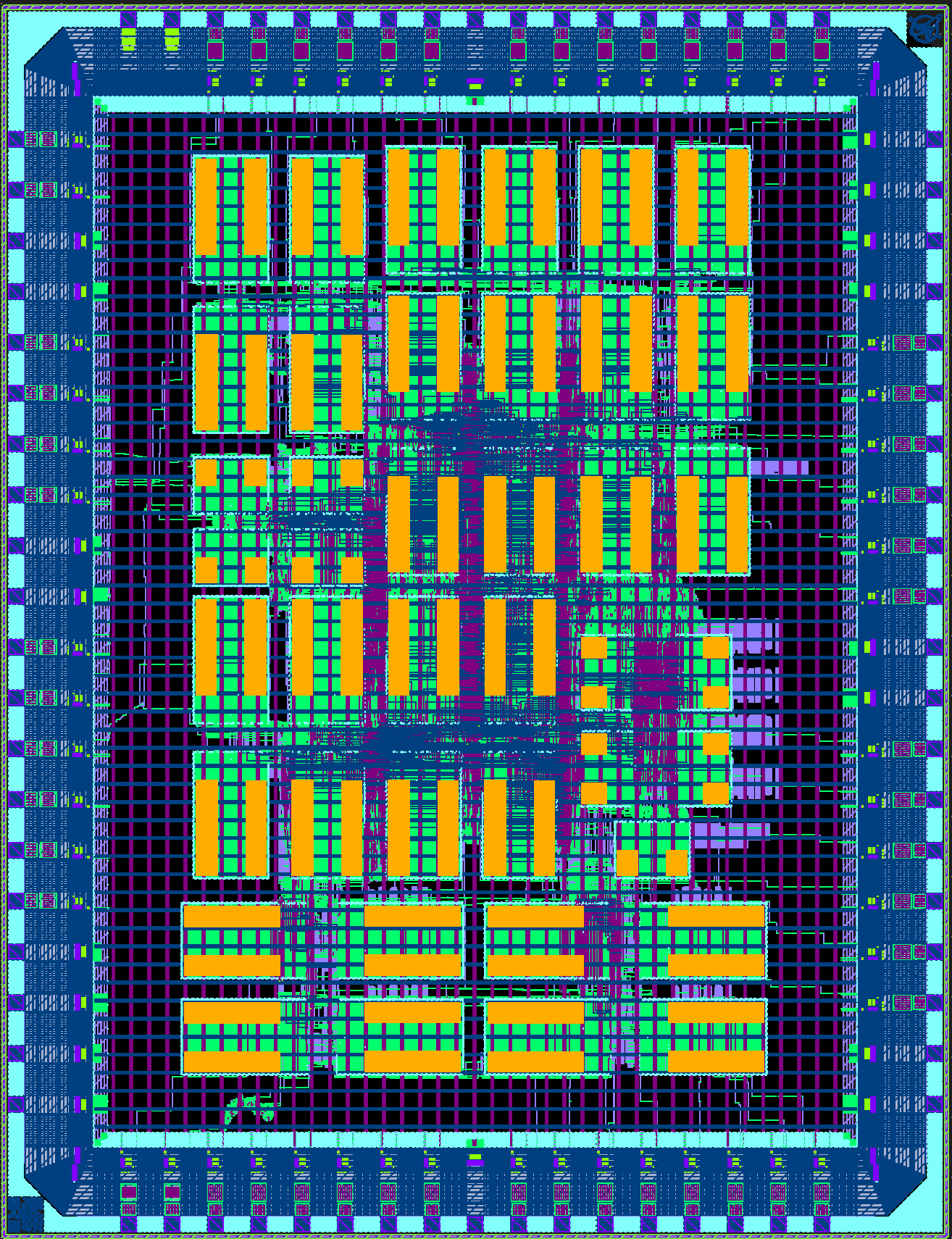
GDS from μTheia project
Experience
Researcher — UCSC Hardware Systems Collective
April 2025 – Present
- Research under Dustin Richmond
- Parameterized element-wise vectorized operations and RMSNorm reduction logic in ternip core, extending support from fixed dimensions (1024/2048/2560) to arbitrary vector lengths
- Implemented ternary weight compression and decompression hardware in SystemVerilog, reducing memory bandwidth requirements for ternip core inference
- SystemVerilog RTL development for ternip core, a hardware accelerator for MatmulFree LLM inference deployed on Xilinx UltraScale+ U250 (300 MHz, 110 tokens/sec)
- Working on TSMC 4nm tapeout incorporating a SiFive RISC-V core for system orchestration
Cofounder — JobsMatch
March 2024 – March 2025
- Co-founded a job matching platform featuring a swipe-based UX, vector embedding resume screening, and a multi-stage applicant tracking system (ATS)
- Built frontend in React/JavaScript and backend with Firebase and Sendbird
- 5 small businesses and startups set to start in pilot program
Undergraduate Researcher — SCIPP
November 2023 – April 2024
- Research under Michael Hance
- Performed hardware characterization testing for temperature and power exposure on detector components
Software Intern — Arteris IP
July 2023 – September 2023
- Developed Python test APIs and script automation for validation of the Ncore Network-on-Chip IP product
- Identified and documented an interfacing defect in the Qt-based UI toolchain, improving test reliability
Education
MS Computer Science and Engineering — UCSC
September 2026 – Present
- Research: Hardware Systems Collective
- Focus: Computer Architecture, VLSI, FPGA, ASIC
- Relevant coursework: Machine Learning (CSE 242)
BS Computer Engineering (Computer Systems) & BS Applied Physics (Computational Physics) — UCSC
September 2021 – June 2026
- Research: Hardware Systems Collective · Santa Cruz Institute for Particle Physics
- Relevant coursework: Chip Design Capstone(CSE 127A/B), Computer Architecture (CSE 220), ASIC Design (CSE 225), Brain Inspired Machine Learning (ECE 110), Computational Physics (PHYS 115), Quantum Computing (PHYS 150), Physics and Machine Learning (PHYS 152), GPU Programming (AM 148)