Marco Frank
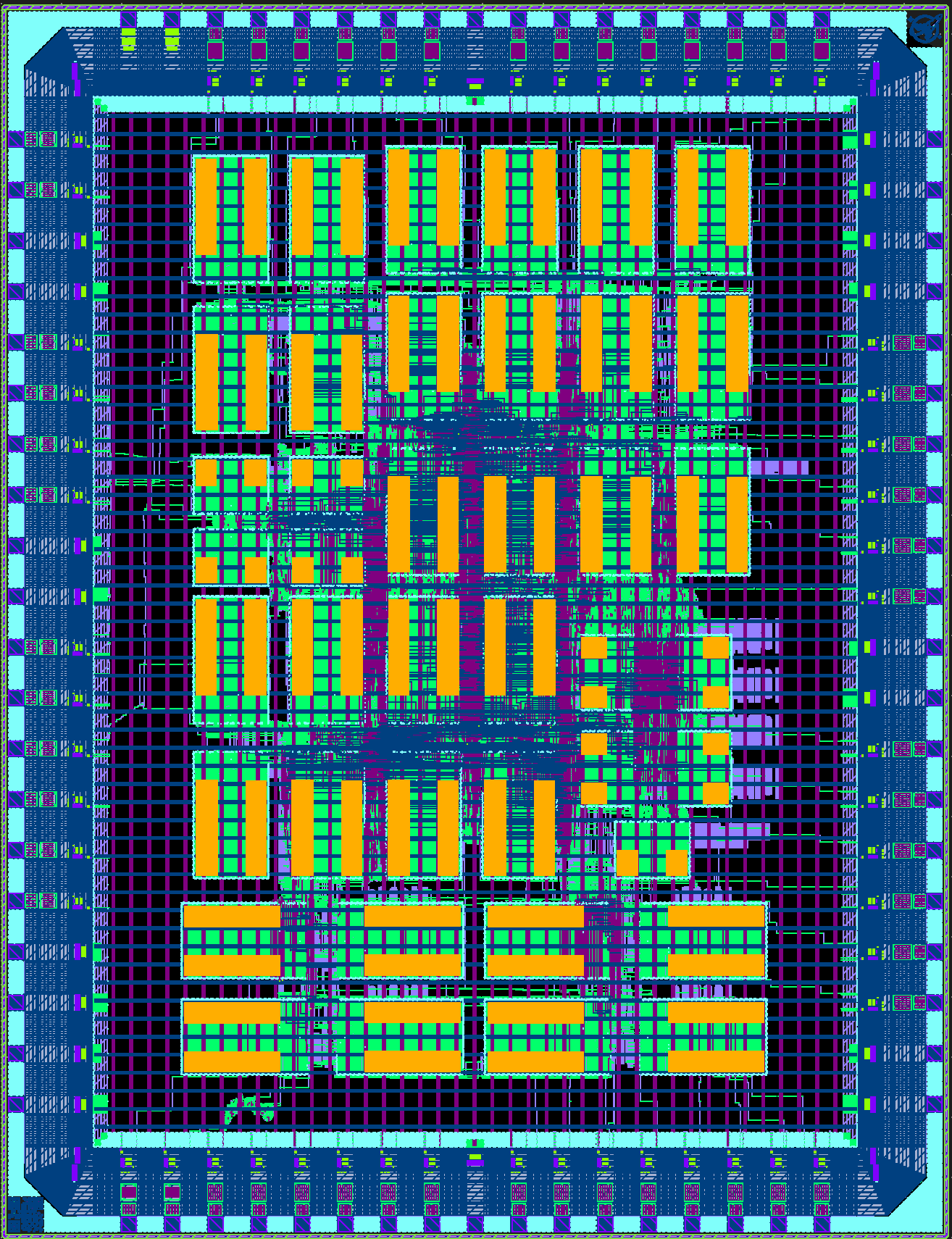
GDS from μTheia project
ASIC Reverse Engineering Puzzle 2026
Jane Street posted on their blog a puzzle on reverse engineering an asic design here. I decided to solve it and here is the write up of it, you can find a PDF version here.
Problem
Given only puzzle.gds (raw chip layout geometry, no labels) and a sample input/output trace, recover the netlist, work out the circuit’s function, and find the specific input that drives success high.
Approach
- All the tools I used were first tested with the warmup. It served as a useful reference so I could compare the backwards results I got over time.
- Extract a netlist from geometry. I used Magic to read
puzzle.gdswith the sky130 process rules and extract transistor-level connectivity, then usedext2spiceto get a SPICE netlist. - Convert SPICE to Verilog. Since Magic recovered real
sky130_fd_sc_hd__*cell names (not anonymized), I could use a custom script to match each instance’s positional SPICE pins against that cell type’s own subckt header to build a proper gate-level Verilog netlist. - Tried direct symbolic solving inside HAL since it worked with the warmup (failed - see Problems).
- Read the real input protocol off the reference waveform instead of assuming it: two 121-bit input bursts separated by a reset, with four flip-flops that have no reset pin and so carry state from burst 1 into burst 2 - a strong hint burst 1 sets something up and burst 2 checks it.
- Bounded model checking with Yosys + SymbiYosys (Boolector backend). I built a formal harness that drives the real netlist through the exact schedule from step 5, leaves all 242
Ibits free, and asks for a satisfying assignment wheresuccessis 1. Found one on the first run. - Independently verified the witness with a standalone Verilator testbench against the original, untouched netlist and real sky130 cell models so a different tool, different code path, and no shared assumptions.
Tools used / built
- Magic - GDS -> SPICE extraction (existing tool).
- KLayout - full-chip rendering of
puzzle.gds(sky130 tech file) to read the physical placement hint and check for hidden content (existing tool). - HAL (
dataflowplugin) - register grouping (existing tool). - Custom equation extractor - walks combinational fan-in per flip-flop and composes real Liberty cell functions into one readable Boolean expression per register.
- Custom protocol reader - samples
rst_n/enable/Iat every clock edge of the reference VCD to reconstruct the true burst/reset schedule. - Yosys + SymbiYosys - bounded model checking harness written against the extracted netlist (existing tools, custom harness).
- Verilator testbench - independent gate-level replay of the witness against real cell models, for verification.
scripts/load_witness_bits.py- general-purpose VCD bit/byte extractor, built specifically to stop hand-transcribing witness data.
Problems encountered
- Hand-rolled SMT inside HAL didn’t scale. Three cycle-by-cycle unroll encodings (Z3 via HAL) worked at 3 cycles but died well before 121: timeout, OOM at 12.8 GB, solver
Unknown
How the final answer was reached
With the real, programmatically-extracted 242-bit input sequence, gate-level simulation of the original netlist against the real sky130 cell models gives an unambiguous result:
success = 1O(read one ASCII byte per clock cycle, cycles 281–295) ="(* TWO STARS *)"
The tooling built during this puzzle was generalized into a reusable flow: github.com/MrPoloGit/FARE-flow.